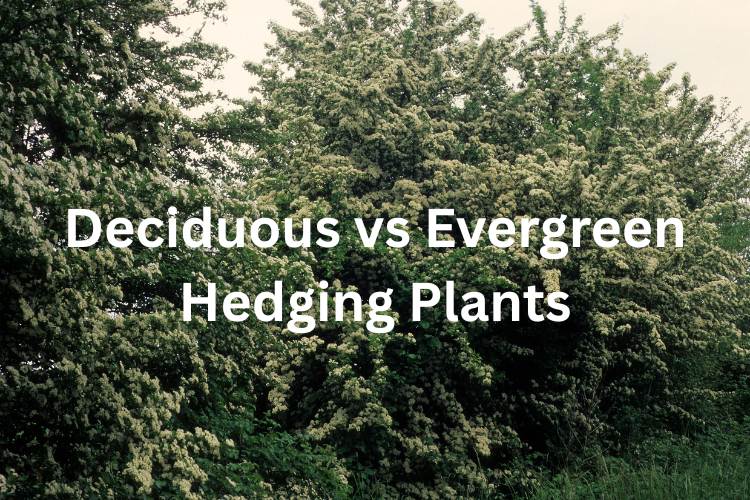
Deciduous vs Evergreen Hedging Plants
1st Feb 2026
In any popularity contest evergreen hedging plants will come out on top every time. Not just because they are always green but they son fast growing too. But deciduous hedging plants are the quiet achievers of the garden. They don’t shout. They don’t rush. And they don’t look the same day in, day out. And that last point is the clincher for me.
Deciduous hedges give you something far more interesting than a never-changing evergreen plant. It’s a hedge that evolves. Fresh green leaves in spring. Dense growth in summer. Rich colour and texture in autumn. And elegant structure in winter. If you like a garden that feels alive and connected to the seasons, deciduous hedging plants are very hard to beat.
Quick reminder: Evergreen hedges are, well, always green while deciduous hedges lose their leaves in autumn and winter before they reappear in spring. So, if you want constant privacy an evergreen hedge is the way to go but if you enjoy watching your garden change and plants sprout new growth a deciduous hedge is the one you want.
Deciduous hedging plants are some of the most recognisable. Those such as hornbeam, and hawthorn that you’ll recognise instantly from country lanes, old gardens, and historic landscapes. And despite losing their leaves wand what I said earlier, many of them still provide excellent screening when established as well as shelter and structure throughout the year.
Let’s take a proper look at why deciduous hedging deserves a place in your garden, which plants work best, and why “losing leaves” really isn’t the downside people think it is.
Why Choose Deciduous Hedging?
Deciduous hedges do things differently and that’s exactly the point we’ve been making throughout this article.
They change with the seasons
If you enjoy watching the garden shift through the year, deciduous hedging is a joy. Buds swell and burst in spring, growth thickens in summer, leaves glow copper and gold in autumn, and winter reveals the underlying branches and structure.
Unlike an evergreen hedges, deciduous hedging never feels static.
They feel more natural
Deciduous hedges will blend into any garden especially in rural, traditional, or wildlife-friendly settings. Even in the most urban or urban gardens, they soften boundaries in a way that hard, solid evergreen walls sometimes don’t.
They’re excellent for wildlife
Many deciduous hedging plants flower, fruit, or provide a snug nest for birds. Birds, insects, and mammals will all love a deciduous hedge, especially those which haven’t been clipped into rigid shapes.
They’re often lower maintenance than you’d expect
Most deciduous hedges only need trimming once a year. Some can even be left longer if you prefer a looser, more natural look.
Clearing Up Myths About Deciduous Hedges
“They’re useless in winter.”
Not true. Many deciduous hedges keep their structure, and some, such as hornbeam and beech, hold onto dry leaves well into winter, providing surprising levels of privacy.
“They’re messy.”
Leaves fall once a year. That’s it. And they make excellent mulch or compost.
“They don’t offer privacy.”
They can do. Just not in the same solid-wall way as evergreens. Think filtered screening rather than total blackout.
The Best Deciduous Hedging Plants
All of the following hedging plants will look a treat in your garden and are more then happy in our climate.
Hornbeam (Carpinus betulus)
If there’s one deciduous hedge that converts evergreen die-hards, it’s hornbeam. It’s tough, reliable, and incredibly adaptable. It copes brilliantly with heavy clay soils, damp ground, exposed sites, and partial shade conditions that defeat many other plants. You can stick them anywhere in other words. And unlike most deciduous hedges, hornbeam holds onto a large proportion of its copper-coloured leaves through winter, giving excellent year-round screening.
Why gardeners love it
- Strong winter structure
- Excellent privacy even when the leaves have dropped
- One trim per year
- Very long-lived
Best for: Boundary hedges, clay soil, low-maintenance privacy
Beech (Fagus sylvatica)
Beech is the classic traditional hedge. Elegant, dense, and beautifully seasonal.
In spring, beech produces soft, fresh green leaves. In summer, it forms itself into a thick, solid hedge. In autumn, it turns rich copper and bronze, before holding onto those leaves through much of winter. It’s one of the few deciduous hedges that still feels “full” when temperatures drop.
Beech prefers well-drained soil and slightly more sheltered conditions than hornbeam, but the visual payoff is huge.
Why gardeners love it
- Stunning autumn colour
- Dense, formal appearance
- Retains leaves in winter
- Responds well to clipping
Best for: Formal hedges, traditional gardens, feature boundaries
Hawthorn (Crataegus monogyna)
Hawthorn is about as British as hedging gets. It is Britain. You’ll see it lining fields, roads, and footpaths across the country. And for good reason.
Hawthorn is tough, fast-growing, and incredibly wildlife-friendly. In spring, it explodes into white blossom. In autumn, it’s heavy with red berries. And its thorny structure provides excellent nesting protection.
It’s ideal if you want a hedge that feels natural rather than manicured.
Why gardeners love it
- Fast establishment
- Incredible wildlife value
- Minimal maintenance
- Traditional countryside look
Best for: Wildlife gardens, rural settings, informal hedges
Field Maple (Acer campestre)
If autumn colour is high on your wish list, field maple is a standout.
This native small tree works beautifully in hedging, especially as part of a mixed hedge. Its leaves turn rich golden yellow in autumn, adding warmth and interest at a time when many plants are fading.
It’s also very tolerant of trimming and poor soils.
Why gardeners love it
- Exceptional autumn colour
- Strong structure
- Native and wildlife-friendly
- Works well in mixed hedges
Best for: Seasonal interest, mixed native hedging
Hazel (Corylus avellana)
Hazel brings something a little different. In late winter, before most plants are awake, hazel produces long yellow catkins. It’s one of the earliest signs that spring is on the way. Later in the year, it produces edible nuts, making it both ornamental and practical.
It’s a fantastic choice for wildlife-focused gardens.
Why gardeners love it
- Early seasonal interest
- Edible harvest
- Thrives with minimal fuss
- Great for mixed hedges
Best for: Wildlife gardens, edible landscapes, informal hedges
What a Deciduous Hedge Looks Like Through the Year
Spring
Fresh green growth, blossom from hawthorn and blackthorn, and catkins from hazel bring the garden back to life.
Summer
Dense foliage provides screening, shelter, and structure. Hedges feel full and vibrant.
Autumn
Leaves turn copper, gold, and bronze. Berries appear. This is peak visual interest.
Winter
Leaves fall, but structure remains. Hornbeam and beech often retain dry leaves, maintaining privacy and definition.
Deciduous vs Evergreen: Which Is Right for You?
This isn’t a competition. It’s about lifestyle and preference.
Choose deciduous hedging if:
- You enjoy seasonal change
- You want a more natural look
- Wildlife matters to you
- You don’t need total winter screening
Choose evergreen hedging if:
- You want constant privacy
- You prefer uniform structure
- You like minimal seasonal variation
And for many gardens?
A mix of both is ideal.
FAQs About Deciduous Hedging Plants
Do deciduous hedges grow quickly?
Some do. Hawthorn is fast. Beech and hornbeam are steady but reliable.
Will I lose privacy in winter?
Not entirely — especially with hornbeam or beech, which hold onto leaves well into winter.
Are deciduous hedges good for small gardens?
Yes. Regular trimming keeps them compact and tidy.
How often do they need trimming?
Usually once a year is enough.
Final Thoughts: A Hedge That Lives with the Seasons
Deciduous hedging plants offer something evergreen hedges never can: change. They grow, flower, colour, fade, and return. This marks the passing of the year in a way that feels deeply satisfying.
They’re practical, beautiful, wildlife-friendly, and surprisingly easy to live with. If you want a hedge that feels part of the landscape rather than imposed upon it, deciduous hedging is the answer.
Explore related guides: